
What Does This Maths Question Actually Ask? A Cambridge Primary Guide
A four-step way to read a maths word problem, identify the quantities and choose a method before calculating.
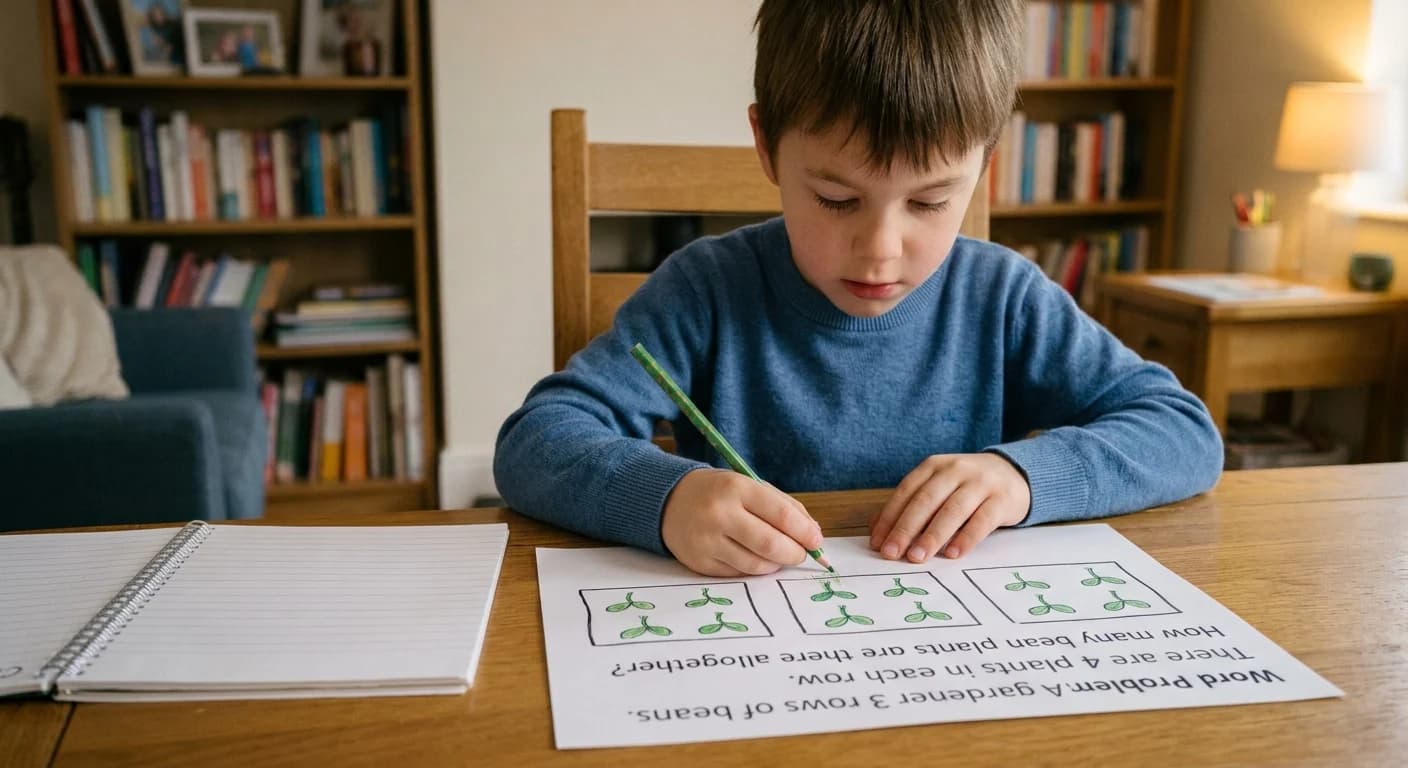
A child can understand a mathematical idea and still find a word problem difficult to start. The question asks the learner to interpret a situation and then decide what mathematics fits it. Separating those steps can make the task easier to discuss.
Try this original example:
A gardener plants 3 rows of beans. There are 4 plants in each row. How many bean plants are there altogether?
Instead of searching immediately for a number to add or multiply, work through four questions.
Read, know, find, check
1. Read the whole question
Read it once for the story, then again more slowly. If a word such as “row” is unfamiliar, draw a quick picture or describe the situation in everyday language.
2. Say what is known
Ask: “What information does the question give us?” In the example, there are 3 rows and 4 plants in each row. A small drawing can show three equal groups of four.
3. Decide what you need to find
Ask: “What will the answer count?” Here, we need the total number of bean plants. Since there are equal groups, multiplication is one suitable way to represent the situation:
3 × 4 = 12
So there are 12 plants. A child can check by drawing three groups and counting the plants, or by adding 4 + 4 + 4.
 Read the whole story, identify what is known, find what is asked, then check the answer.
4. Check whether the answer fits
Read the question again with the answer. Does 12 count individual plants, rows, or something else? Include the unit in the response: 12 bean plants.
Try the same relationship as division
A related question might say: “There are 12 bean plants shared equally across 3 rows. How many plants are in each row?” The same quantities now describe a sharing situation:
12 ÷ 3 = 4
The multiplication fact 3 × 4 = 12 can help check the division answer. Drawing equal groups or using counters can make the relationship visible.
Don’t rely only on “key words”
Words such as “altogether,” “left” or “each” can be useful clues, but they do not choose an operation by themselves. The child still needs to understand what is happening and what the answer should represent. A picture, a small model or a retelling can help before calculating.
Useful parent prompts include:
- “What is happening in the story?”
- “What does each number describe?”
- “What are we trying to find?”
- “Could a drawing show the same relationship?”
- “What unit should the answer use?”
Give the learner time to explain their idea. If the first method does not work, return to the story and model the quantities rather than simply naming an operation.
Try the interactive card game
Draw a Challenge first, then choose number and operator cards that can solve it. The cards stay face up, so no one gets stuck with an impossible random equation. The Start level uses addition and subtraction; the Facts level uses multiplication and exact division. Try it together or solo.
Play in your browser
Maths card Challenge
Draw a Challenge first. Number and operator cards stay face up, so choose cards that can solve it.
Two ways to make 12
Build two different addition equations that equal 12.
Different ways found: 0 / 2
Number cards
Face up · choose any · two copiesOperator cards
Choose one · equals stays in playChoose number cards and an operator to solve the Challenge.
 The printable uses 63.5 × 88.9 mm cards for numbers, operations and challenges.
The printable includes the same two levels as the simulator. Choose the level that fits the learner; the cards are not a placement test or a year-by-year curriculum map. Counters and drawings are welcome ways to show thinking.
The most useful first step is often to ask the child to explain the situation in their own words. Once the quantities and the question are clear, they can choose a method and check whether the answer makes sense.