Show Your Working with AI: A Teacher's Guide to Transparency
Help students explain how they used AI, what they checked, and what they contributed—without turning prompt counts into a grade.
When students use generative AI for schoolwork, a polished final answer may not show what they understood, what they checked, or what they contributed. A short, clear account of the process can make AI use more transparent and create a useful conversation about learning.
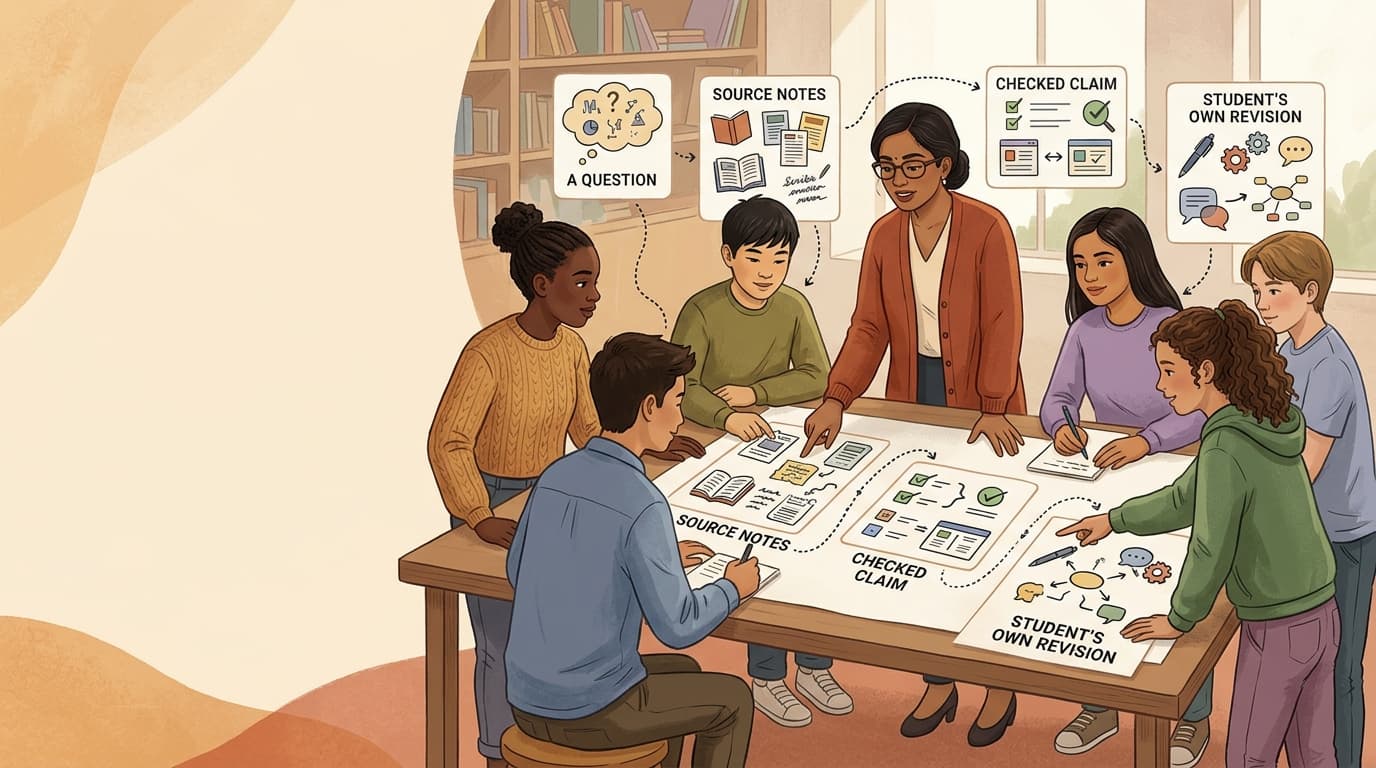
For teachers who value openness without surveillance, make the important learning choices visible—not every keystroke. A short account can show what help students sought, what information they relied on, how they checked the response, and how the work changed, without asking them to hand in private thoughts or treating a long prompt list as proof of effort.
A simple AI process record
For an assignment where AI use is permitted, invite students to add a short note such as:
- Purpose: What part of the task did I use AI to help with?
- Question or prompt: What did I ask it to do? I can summarize rather than copy a prompt that contains personal information.
- Grounding: What class notes, sources or instructions did I provide or consult?
- Checking: Which claims did I verify, and against what reliable source?
- My contribution: What did I change, reject, explain or create myself?
The note can be a few sentences, a checklist or a brief oral explanation. Match its length to the task. For a small activity, one or two relevant details may be enough.
Should students report how many attempts they made?
Some teachers ask students to say how many tries it took to get an output they used. That can prompt reflection: Did changing the question or prompt improve the result? Did adding a source help? Did the student notice that a confident answer was unsupported?
But an attempt count is context, not a measure of learning. More prompts do not automatically mean more understanding, and a student may learn to question an answer quickly. If you collect the count, pair it with a short explanation of what changed and why; do not grade students for a higher number.
Set expectations before the task
Tell students which forms of help are allowed, what must be their own work, and whether AI use needs to be disclosed. Explain that outputs can be inaccurate even when they sound certain. Students should not enter personal, sensitive or confidential information into a tool unless the school has explicitly approved that use.
Keep the process record proportionate, age-appropriate and consistent with school policy. Younger learners may need to talk through the steps with a teacher; older students can take more responsibility for documenting and checking their work.
The aim is not to catch students out. It is to help them explain their decisions, check claims and take responsibility for the work they present.