
Short Stories for Kids in English: Read a Fable Together
Read a fable-inspired story excerpt for ages 7–11, then use simple prompts to notice vocabulary, follow the plot, and share ideas.
Looking for short stories for kids in English? Start with this illustrated excerpt from an original fable-inspired story for readers around ages 7–11. Then try a few light-touch prompts to notice vocabulary, follow the events, and share an idea. Read for enjoyment; it is not a test.
A story can be a useful reading practice
There is no single word count that defines a short story. This excerpt comes from a fuller story with a beginning, a problem, attempts to solve it, and a resolution. A child can read independently, take turns with an adult, or listen while someone reads aloud.
The excerpt is an original BXB FutureLabs adaptation inspired by the traditional fable premise of a crow reaching water in a pitcher. Its characters, scenes, wording, and added details were written for this collection; it is not copied from a modern edition.
Read an excerpt: The Crow and the Pitcher
The excerpt is in English so readers can listen to the same wording they see below. Choose a voice and speed if your browser offers them, or simply read the text yourself.
The Crow and the Pitcher
Words to notice: rim, pebble, measured, shallow, and level.
During a long, dry summer, Sora the crow searched the garden for water. The stream had shrunk to a few quiet puddles, and the familiar birdbath was cracked and empty. Her friends Pip the sparrow and two finches searched with her.
From a branch above the garden, Sora spotted a clay pitcher half hidden in the grass. A blue line circled its neck, marking where the water usually reached. At the bottom, a little water caught the light—but Sora's beak could not reach it.
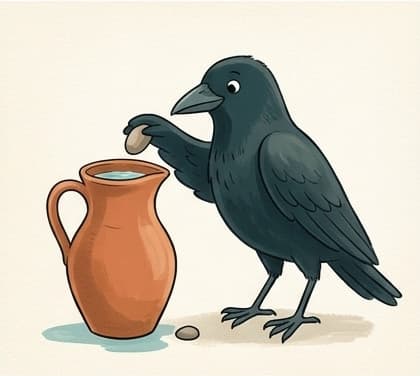
She tried tipping the pitcher. It rocked, then settled back into the dust. A harder push might crack the clay and spill the water. Sora stopped to look again. Small pebbles lay along the path. She dropped one into the pitcher. The water rippled; its surface seemed to rise a little.
Pip was not convinced. Sora tried another pebble and watched closely. The birds began comparing stones by size, adding them one at a time, and checking the water after the ripples settled. Some stones helped more than others; one was too wide to fit through the opening.
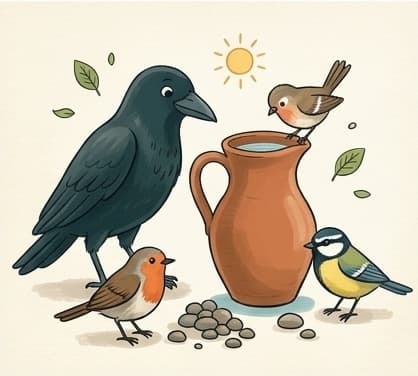
As the water rose, the birds noticed a pebble wedged near the pitcher’s neck. They paused instead of pushing harder. Sora held the rim steady while the finches supported the base. Together they shifted the pitcher just enough for the pebble to slide down without spilling the water.
The water was still low, and the garden held other possible sources—but some were too heavy or unsafe for the birds to reach. They chose what they could do, kept track of what they observed, and asked the gardener for help with the rest.
This is an excerpt; the downloadable collection contains the complete story and four more expanded fable-inspired stories.
After reading: four ways to explore the story
You do not need to quiz a child on every detail. Choose one prompt, listen to the response, and follow the idea that interests them.
- Notice a clue: What did Sora observe before changing her approach?
- Follow the reasoning: How did the birds compare different pebbles? What did they learn from the water level?
- Consider a choice: Why did they leave the heavy barrel alone and ask the gardener for help?
- Retell or extend: Explain the story in four steps—problem, idea, test, result—or draw a different safe solution and explain how Sora could test it.
Practise vocabulary without rushing
Invite the learner to use context before reaching for a dictionary. For example, what might shallow mean in “a wide, shallow dish”? Which details help? After checking a word, ask the child to use it in a new sentence or point to another example.
The vocabulary list is a starting point, not a list to memorize. It is fine to pause on just one or two words. Discussing an idea in a family’s strongest language can help clarify meaning; then return to the English word or sentence in the story. A multilingual home language is a resource, not a barrier.
Make the reading fit the child
A younger reader might listen, answer aloud, or draw a scene. An older reader might explain why a character changed plans, compare two possible solutions, or write an alternative ending. Let the child choose a comfortable way to respond, and add a challenge when they are ready.
This is supplementary reading material, not a year-by-year Cambridge Primary syllabus or an assessment of English ability. Follow the child’s teacher for curriculum-specific practice. The aim here is to enjoy a story and make space for reading, vocabulary, and conversation.
Want the full collection?
The free story above is included in the downloadable ebook, alongside four more expanded fable-inspired stories, original illustrations, vocabulary lists, reading prompts, and two writing activities. The download form requests your name and email to deliver the resource; it does not ask you to sign up for unrelated marketing.