
10 Cambridge Primary English Activities Families Can Try at Home
Ten low-preparation ways to practise reading, vocabulary and clear sentences using texts and materials you already have.
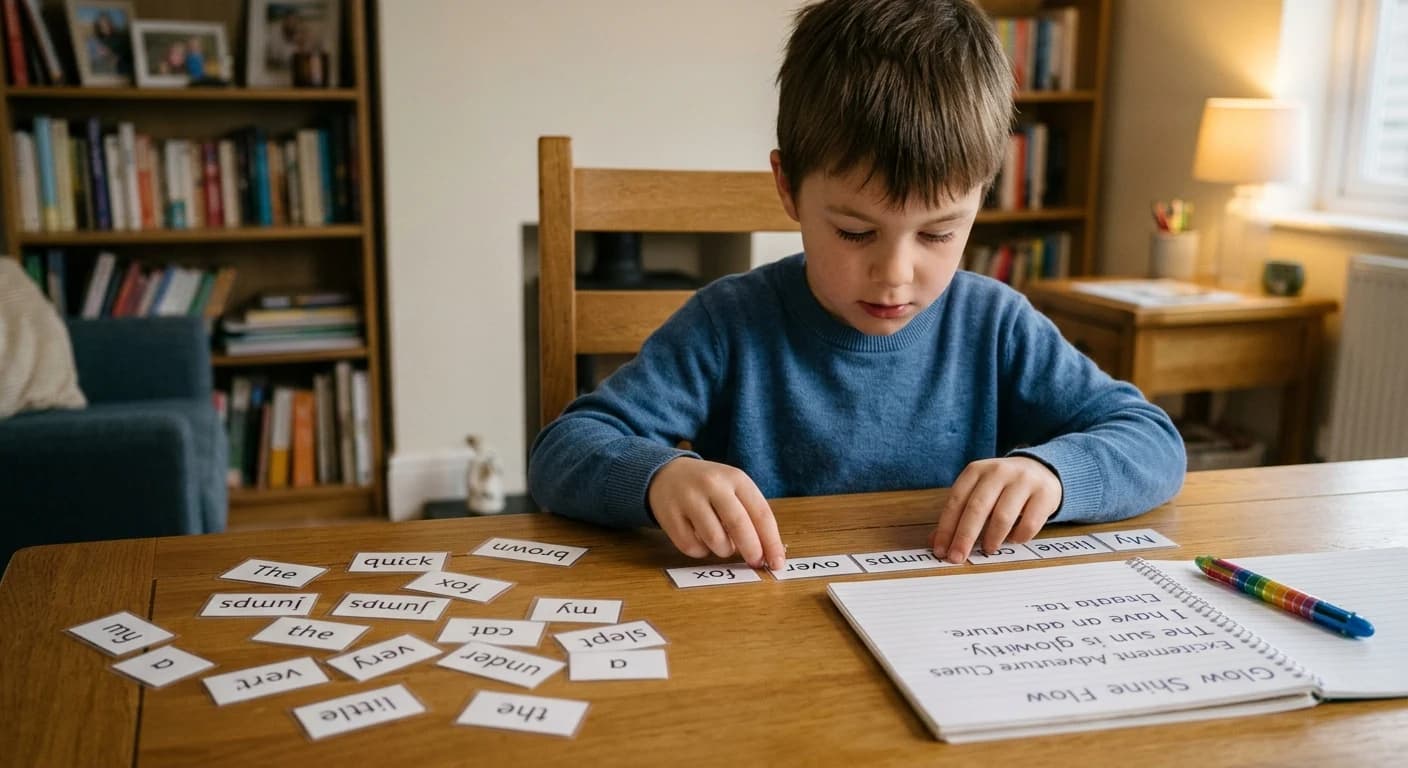
English practice at home can start with a conversation, a short text or a few words on a piece of paper. These activities use ordinary things families may already have; there is no need to buy a workbook or finish all ten at once.
Choose an activity that suits your child’s current reading and writing comfort. A younger learner might answer aloud or draw. An older learner might write a few sentences or explain how they reached an answer.
Reading and vocabulary
1. Find a word in context
Choose one word from a short text that your child does not use often. Read the whole sentence, look for clues, guess its meaning, and then check. Ask your child to use the word in a new sentence.
2. Retell in three moments
After reading a story or a short passage, ask what happened first, next and last. The child can tell the story, draw three boxes, or write a phrase for each moment.
3. Ask a better question
Take turns asking questions about a text. Start with “Who?”, “What?” or “Where?” Then try “Why do you think that?” or “Which detail makes you think so?” Point back to the text when possible.
4. Sort words by meaning
Pick five to eight words from a text or a topic the child is learning. Sort them into groups—for example, words that describe a place, an action or a feeling. Ask the child to explain one choice.
 Sort a few words, then ask the learner to explain one choice.
5. Give a one-sentence summary
Invite your child to explain the main idea in one sentence. If it is difficult, ask: “What is this mostly about?” and “What is one important detail?” A drawing with a spoken sentence works too.
Speaking and writing
6. Add one useful detail
Begin with a simple sentence such as “The bird flew.” Add one detail at a time: where did it fly, when, or how? Compare the versions and discuss which detail helps the reader picture the scene.
7. Make a mini comic
Draw three simple panels. Add a short caption to each panel, then read the captions in order. Practise capital letters at the start and a suitable punctuation mark at the end.
8. Explain how to do something
Ask your child to explain a familiar activity, such as packing a school bag or making a sandwich. Listen for steps such as “first,” “next” and “finally.” Then try following the instructions together.
9. Change the point of view
After a story, choose one event and retell it from another character’s point of view. The goal is to think about what that character might know or feel—not to produce a long piece of writing.
10. Build a sentence together
Choose a “who or what” and an action, then make a complete sentence. Add a place, time or detail. Read it aloud and check that it sounds complete and has an end mark.
The printable sentence-builder cards below provide original prompts for this last activity. Cut them out, keep the two card types in separate piles, and draw one from each pile to begin a sentence. Children can add their own details or invent new cards.
Try reading a sentence aloud
Draw a WHO / WHAT and ACTION prompt, then read the sentence aloud. Where supported, on-device speech recognition produces a transcript that is compared with the sentence. It can help you notice words the recognizer matched or missed, but it is not a pronunciation test or a measure of English level.
Play in your browser
Read a sentence aloud
Draw a WHO / WHAT and an ACTION card, read the sentence, then compare the words recognized.
Draw a sentence to see the two printable card prompts and begin.
Microphone privacy: The US-English model (~40 MB) downloads from the Vosk-Browser model host only after you request it; the ~3 MB WASM runtime loads then too. Microphone access starts only when you press Start reading. Audio is processed in this browser and is not uploaded to BXB or the model host; BXB does not receive or store audio or transcripts. First use may need about 300 MB of memory. Accents and British spellings can affect recognition, so this is not a pronunciation test or an English-level score.
Get the printable sentence-builder cards
Keep practice manageable
One activity is enough for a short session. Let your child choose between two options, give them time to think, and notice what they can explain. If an activity feels frustrating, simplify it or try another day.
These ideas are general family activities, not a year-by-year Cambridge syllabus or a measure of progress. Use school guidance when you need practice matched to a specific classroom topic.